
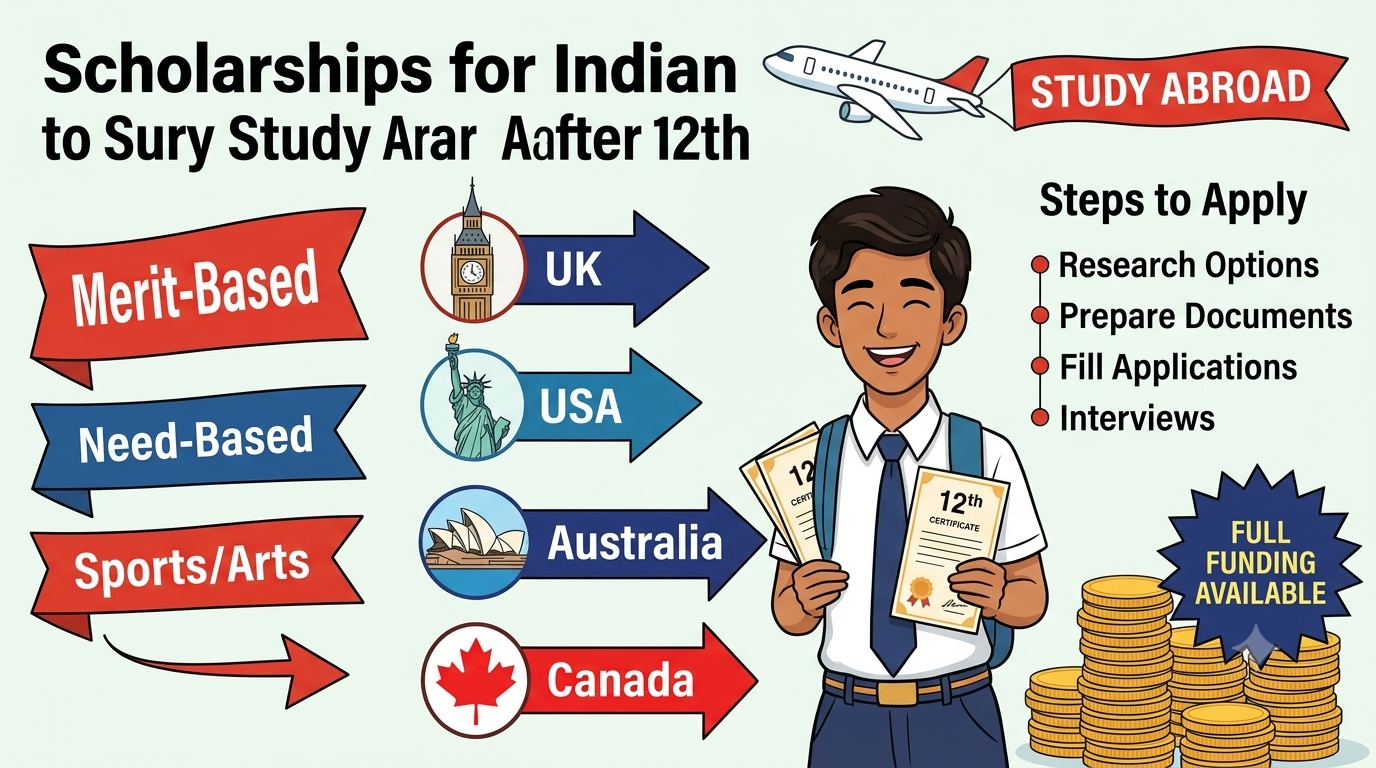
Studying abroad after Class 12 gives Indian students access to international universities, diverse academic systems, global exposure, and new career opportunities. However, tuition fees, accommodation, travel, and living expenses can make overseas education financially challenging for many families.
Students can explore several funding options before deciding that studying abroad is beyond their financial means. Scholarships for Indian students to study abroad after 12th include merit-based university awards, need-based financial aid, government scholarships, and funding from foundations or other organisations. The most suitable option depends on academic performance, financial circumstances, preferred destination, and chosen undergraduate programme.
What matters most is finding scholarships that will accept you as an undergraduate or bachelor’s student. There are certain popular scholarships offered by the Government of India that are for students pursuing master’s degrees or PhDs and not for those students who have completed their Class 12 education. The Ministry of Education also provides details on external scholarships awarded by overseas governments and institutions.
Table of Contents
What Are Scholarships for Indian Students to Study Abroad After 12th?
These scholarships provide financial support to Indian students pursuing undergraduate degrees at universities abroad after completing Class 12. Depending on the programme, the funding may cover tuition fees, living expenses, accommodation, travel, or other education-related costs.
Financial assistance may be provided for one or more elements of the total education cost, depending upon the scholarship:
- Tuition fees
- Accommodation
- Living expenses
- Books and academic materials
- Health insurance
- Travel or airfare
- Application-related expenses
- Other education-related costs
Not all scholarships will pay for all these costs. The definition of a full scholarship can vary from one university to another; applicants should always check the detailed conditions of the funding.
Typically there are four major categories to explore:
| Scholarship Type | Usually Offered By | What It May Cover |
| Merit-based scholarship | Universities | Partial or full tuition |
| Need-based financial aid | Universities/organisations | Tuition and/or living costs |
| Government scholarship | Foreign governments | Tuition, living costs and other benefits depending on the programme |
| External/private scholarship | Foundations and organisations | Varies by programme |
For instance, EducationUSA maintains a financial-aid database of financial aid and scholarship opportunities available to international students in the United States. There are some opportunities in the list which are limited to undergraduate students.
Why Should Indian Students Apply for Scholarships After Class 12?
The main benefit of a scholarship is that it can reduce the financial burden of overseas education for students and their families.
Going overseas is more than just tuition. Students will have to take into account accommodation, food, local transport, health insurance, visa costs, flights and personal expenditure. In the case of undergraduate students, EducationUSA strongly advises students to make a comprehensive financial plan not only for the tuition but also for their expenses for living away from home.
Scholarships also allow them to think about universities they may not have been able to afford otherwise. Scholarships for Indian students to study abroad after 12th can help families manage tuition fees and other education expenses.
Students should choose a university based on academic quality, recognition, course suitability, career opportunities, scholarship renewal conditions, and the total cost remaining after funding.
Types of Scholarships to Consider After 12th
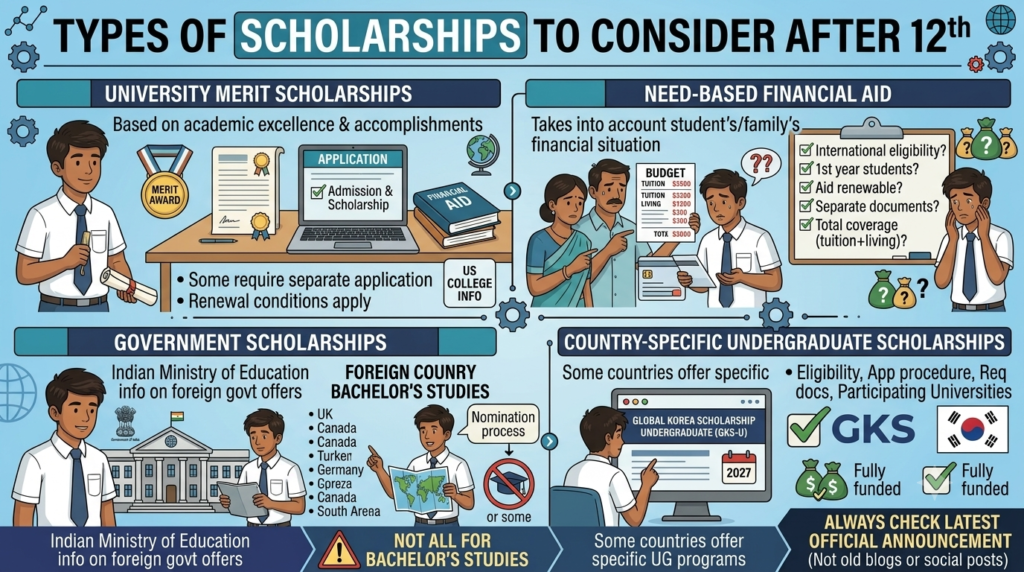
Scholarships for Indian students to study abroad after 12th include merit-based, need-based, university-specific, and government-funded options.
- University Merit Scholarships
A number of universities offer scholarships to international students based on their academic excellence and other accomplishments.
Some scholarships are awarded automatically when students apply for admission, while others require a separate scholarship application.
EducationUSA, for instance, provides information about undergraduate international scholarships from U.S. colleges and universities. Others are based on academic achievement and may be continued for several years, depending on students’ academic requirements.
Indian students looking for scholarships to study abroad after 12th should check the international admissions and financial aid pages of their shortlisted universities. - Need-Based Financial Aid
Financial aid based on need takes into account a student’s or family’s financial situation.
Requirements and availability vary from country to country and from university to university. International students are advised never to take for granted that they will be funded because they have financial need.
Consider the following points at the time of comparing universities:
Whether international students are eligible
Whether students in their first year are eligible for assistance
If the aid is renewable and for how long.
Whether separate financial documents will be required.
The university will cover the tuition fee only or the tuition fee plus living expenses. - Government Scholarships
Government-funded scholarships can be valuable funding options, but students must check whether each programme supports undergraduate study after Class 12.
The Ministry of Education, Government of India, provides information on scholarships offered by other countries and institutions abroad. In some cases, applicants must submit their own applications to the country or institution of interest, and in some cases, they will also go through a nomination process.
The Ministry’s advertised information also reveals that there are a number of renowned international government scholarships for postgraduates. Hence, students who complete their Class 12 education should not presume that all government scholarships abroad are available for bachelor’s studies.
Students searching for scholarships for Indian students to study abroad after 12th should confirm that each programme accepts undergraduate applicants. - Country-Specific Undergraduate Scholarships
The government of some countries offers undergraduate scholarship programmes.
One example is South Korea. Global Korea Scholarship Undergraduate (GKS-U) application information is available in the Korean government’s Study in Korea portal, which includes eligibility, application procedures, required documents, and participating universities. The Global Korea Scholarship for Undergraduate Degrees 2027 is currently listed in the official scholarship notices.
The Global Korea Scholarship for Undergraduate Degrees (GKS-U) is one option for students exploring scholarships for Indian students to study abroad after 12th, subject to the current eligibility requirements.
The eligibility, application process, available universities and deadlines, however, may vary from one intake to another. Always make sure that the student uses the latest official announcement, not an old blog or social media post.
Examples of Scholarships and Funding Routes
The table below offers a useful starting point. Before applying, it is crucial to confirm the current intake.
| Scholarship/Funding Route | Country/Region | Undergraduate Relevance | What to Check |
|---|---|---|---|
| Global Korea Scholarship (GKS-U) | South Korea | Yes | Current annual guidelines and eligible universities |
| University merit scholarships | USA and other countries | Often available | Academic requirements and renewal rules |
| University financial aid | USA and other destinations | Depends on the institution. | International student eligibility |
| University scholarships | Germany | Available in some cases | Institution and programme-specific rules |
| External scholarships | Multiple countries | Varies | Degree level and nationality requirements |
| Indian government external scholarship information | Multiple countries | Mostly varies by programme | Current Ministry notification |
Students considering Germany should research funding opportunities offered by universities, foundations, and other recognised organisations. The availability of scholarships varies by programme and academic level, so applicants should check the official eligibility requirements before applying.
Scholarships for Indian Students to Study Abroad After 12th: Eligibility
Eligibility for scholarships for Indian students to study abroad after 12th varies by country, university, academic performance, and scholarship programme.
The requirements may be:
- The completion of class 12 or equivalent qualification
- Minimum academic marks or grades
- Admission/conditional admission to an eligible university
- Age requirements
- Citizenship requirements
- English-language proficiency
- Standardised test scores (where applicable)
- Extracurricular achievements
- Leadership/community involvement
- Financial-need documentation
- A personal statement or scholarship essay will be required.
- Letters of recommendation
There are scholarships with extra requirements for the subject chosen, country, university or the background of the applicant.
Academic Performance
Excellent Class 10 and Class 12 results can provide an undergraduate scholarship application with a solid boost, especially for merit-based scholarships.
However, marks are not necessarily the only factor. Other components of the application may be considered by universities depending on the scholarship, including essays, activities, leadership, academic interests, achievements and more.
Extracurricular Activities
Students should not collect certificates simply to make their applications look impressive. They should highlight meaningful activities that demonstrate commitment, skills, leadership, or contributions to their communities.
Activities that have relevance tend to be more useful when they show some interest or contribution. Examples can include:
- Volunteering
- Sports
- Student leadership
- Competitions
- Research or academic projects
- Cultural activities
- Community initiatives
- Entrepreneurship
- Subject-related projects
Documents Required for Scholarship Applications
Although the precise list of documents varies, students should have a basic application folder ready well in advance.
Students applying for scholarships for Indian students to study abroad after 12th should prepare academic records, identification, recommendation letters, and financial documents as required.
| Document | Why It May Be Required |
|---|---|
| Class 10 marksheet | Academic record |
| Class 12 marksheet/certificate | Proof of school qualification |
| Passport | Identity and international travel documentation |
| Academic transcripts | Detailed academic record |
| Statement of purpose/personal statement | Explains goals and motivation |
| Letters of recommendation | Academic or personal reference |
| English-language test score | Proof of language ability, where required |
| CV/resume | Summary of achievements |
| Financial documents | Required for need-based aid |
| Certificates | Evidence of achievements |
| Admission letter | May be required by certain scholarships |
Students should accurately scan their documents and ensure that their name, birthdate, and other personal details are spelled consistently throughout all of their applications.
How to Apply for Scholarships to Study Abroad After 12th
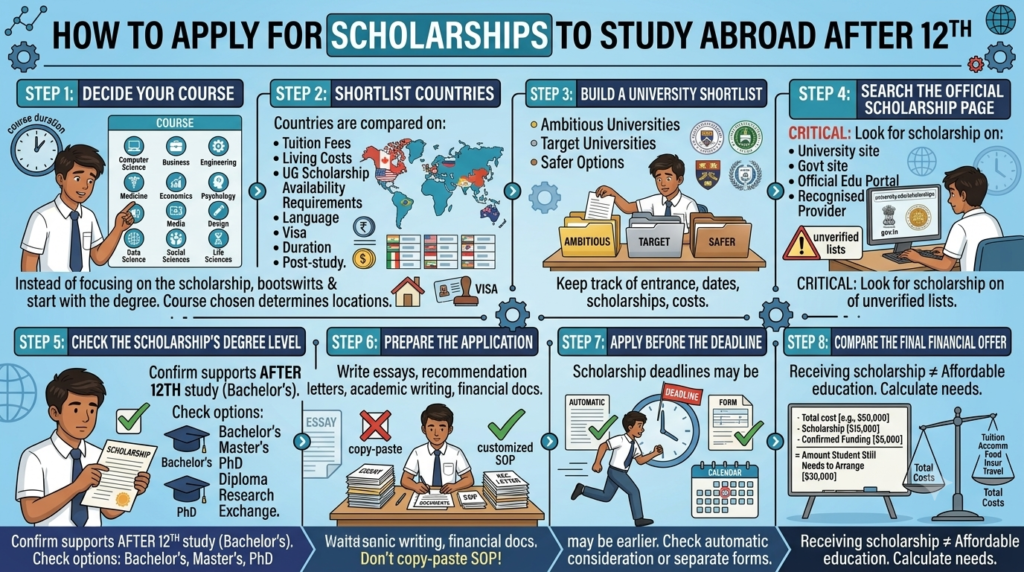
To find scholarships for Indian students to study abroad after 12th, shortlist courses and universities, check official requirements, and track application deadlines.
Step 1: Decide Your Course
Instead of focusing on the scholarship, start with the degree.
For instance, choose whether you wish to study:
- Computer Science
- Business
- Engineering
- Medicine
- Economics
- Psychology
- Media and Communication
- Design
- Data Science
- Social Sciences
- Life Sciences
The opportunities for scholarships can vary based on the course and location.
Step 2: Shortlist Countries
Countries are compared based on:
- Tuition fees
- Living costs
- Undergraduate scholarship availability
- Admission requirements
- Language requirements
- Visa requirements
- Course duration
- Post-study opportunities
Don’t choose a nation just because it’s cheap or fully funded according to an internet article.
Step 3: Build a University Shortlist
Create three categories:
- Ambitious universities
- Target universities
- Safer options
Keep track of entrance requirements, application dates, scholarship options, and tuition costs for each university.
Step 4: Search the Official Scholarship Page
This is among the most crucial actions.
Look for the scholarship on the following official website:
- The university
- The country’s government
- The country’s official education portal
- A recognised scholarship provider
Since scholarship notifications and timetables are subject to change, the Ministry of Education itself recommends students to frequently check official sources.
Step 5: Check the Scholarship’s Degree Level
Make sure a programme supports the following before investing any time in it:
- Bachelor’s
- Master’s
- PhD
- Diploma
- Research
- Exchange study
A common error that may be avoided with this easy check is applying for an important scholarship that does not accept students right away after Class 12.
Step 6: Prepare the Application
Prepare scholarship essays, letters of recommendation, academic transcripts, and financial documents according to the requirements of each programme.
Don’t copy and paste the same statement of purpose and submit it everywhere.
Step 7: Apply Before the Deadline
Scholarship application dates may be earlier than or the same as university application dates.
Either students can be automatically considered for merit scholarships, or they must complete a separate form for it at some universities.
Step 8: Compare the Final Financial Offer
Receiving a scholarship does not necessarily mean the education is affordable.
For example:
Total cost − scholarship − other confirmed funding = amount the student still needs to arrange
This calculation should cover tuition, accommodation, food, insurance, travel and any other unavoidable costs.
How Much Money Can a Scholarship Cover?
The amount of a scholarship is not fixed.
The amount of the award may differ from one university to another; it may be a few thousand dollars per year, or perhaps a much higher amount. Some scholarships may pay for tuition only and not include room and board or living expenses.
For instance, EducationUSA now offers undergraduate scholarships of varying amounts, and some institutions will provide international students a scholarship that can be renewed annually.
When comparing scholarships for Indian students to study abroad after 12th, calculate the remaining cost after deducting confirmed funding from tuition and other expenses.
| Funding Level | What It May Mean |
|---|---|
| Partial tuition scholarship | Reduces tuition but leaves a remaining tuition balance |
| Full tuition scholarship | Covers eligible tuition but may not cover living costs |
| Tuition + living support | Covers tuition and specified living expenses |
| Fully funded | May cover several major expenses, subject to the programme’s exact rules |
Before considering an award to be fully funded, always read the formal scholarship terms.
Is Germany Affordable for Indian Students?
Germany may be an affordable option for some international students because many bachelor’s programmes at public universities do not charge tuition fees. However, exceptions apply, and students may still need to pay semester contributions, living expenses, and tuition fees for certain institutions or programmes. They should check the costs for their chosen university before applying.
As stated by DAAD, students from outside the EU/EEA must provide proof of financial means for studying in Germany and may have to pay tuition fees in certain cases, such as in some states or in certain programmes.
Eligibility for admission should also be carefully checked. According to DAAD’s admission guidance, international students are required to have an appropriate higher education entrance qualification, and the DAAD admissions database makes an initial, but non-binding, estimate of qualifications.
So some students may find it to be an affordable choice for Germany, but it does not mean that Germany is free education for everyone.
Common Mistakes to Avoid
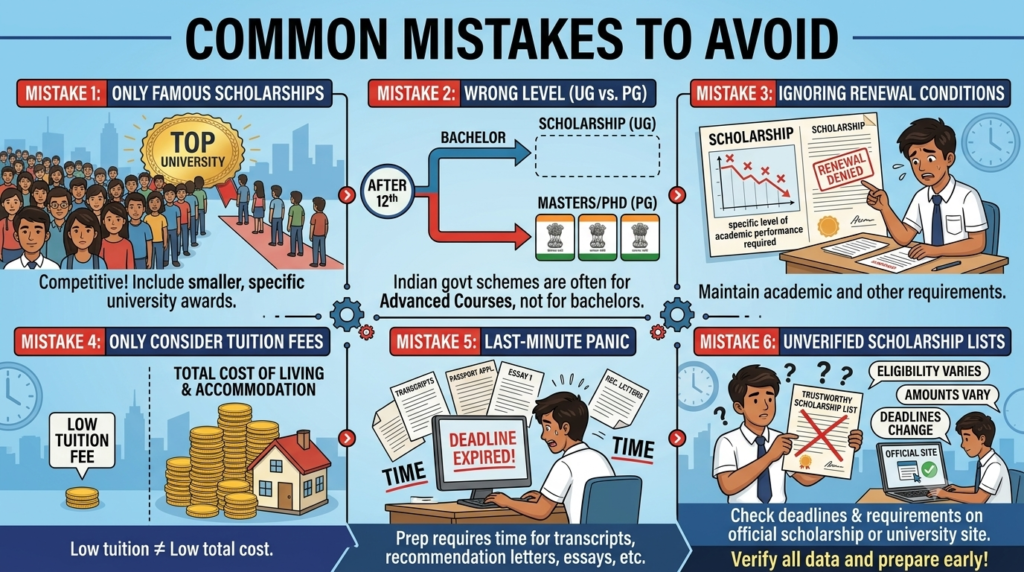
1. Applying for Only Famous Scholarships
Scholarships that are popular may be very competitive. Create a larger list, including scholarships that are specific to a particular university, and other smaller awards.
2. Mistaking Postgraduate Scholarships for Undergraduate Scholarships
After Class 12, this is particularly significant for Indian students. There are several government schemes in India for studying abroad for advanced courses, not for bachelor courses.
3. Ignoring Renewal Conditions
A scholarship can be renewed only if the student has a specific level of academic performance or meets other requirements.
4. Only considering tuition fees
Low tuition fees do not necessarily mean that the total cost of studying abroad will be low. The cost of living and accommodation can have a major impact.
5. Leaving Things Until the Last Minute
The preparation of transcripts, passports, recommendation letters, essays and test scores requires time.
6. Relying on Unverified Scholarship Lists
Scholarship eligibility criteria and amounts may vary, and deadlines are subject to change.
Students must check all essential information on the official scholarship or university site prior to applying for a scholarship.
What Indian Students Should Do Next?
Students searching for scholarships for Indian students to study abroad after 12th should create a tracker to record universities, funding options, deadlines, and application status.
| University | Country | Course | Scholarship | Deadline | Tuition After Scholarship | Living Cost | Status |
|---|---|---|---|---|---|---|---|
| University 1 | USA | Bachelor’s | Merit Scholarship | Check the official site. | Calculate | Calculate | Research |
| University 2 | South Korea | Bachelor’s | GKS-U | Check current notice. | Check official rules. | Check official rules. | Research |
| University 3 | Germany | Bachelor’s | University/External | Check the official site. | Calculate | Calculate | Research |
| University 4 | UK | Bachelor’s | University Scholarship | Check the official site. | Calculate | Calculate | Research |
| University 5 | Other | Bachelor’s | International Scholarship | Check the official site. | Calculate | Calculate | Research |
It’s best to apply to a variety of different universities and scholarship categories rather than relying on one scholarship.
Students are also advised to continue to follow official sources for the changes in scholarship programmes and annual application cycles. The Ministry of Education provides information on external scholarships and country-specific external scholarship information portals, like Study in Korea, post external scholarship announcements.
FAQs About Scholarships for Indian Students to Study Abroad After 12th
1. Is it possible for Indian students to avail scholarships for foreign education after Class 12?
Yes. Indian students may be eligible for university scholarships, government-funded programmes, and external scholarships for undergraduate study abroad. Eligibility depends on the scholarship’s requirements, including nationality, academic performance, chosen course, and university.
2. What are the top scholarships for Indian students after 12th?
The best scholarships for Indian students to study abroad after 12th depend on their academic profile, preferred country, and funding needs. Compare undergraduate eligibility, scholarship coverage, university requirements, and application deadlines before choosing.
3. Can I get a fully funded scholarship after 12th?
Yes, there are fully funded undergraduate opportunities, but they are very specific and competitive. Students should be careful about what they are actually getting as part of the scholarship and not assume that fully funded means all costs are covered.
4. Is there an opportunity to study abroad without having to pay tuition fees?
Yes, in some cases. Students may receive full-tuition scholarships or enrol in programmes at institutions that charge little or no tuition. However, accommodation, living expenses, insurance, travel, and other costs may still apply.
5. Where can I discover a trustworthy scholarship for Indian students?
Students can find scholarships for Indian students to study abroad after 12th through official government portals, recognised scholarship providers, and university websites. Always verify eligibility and deadlines before applying.
Conclusion
Finding scholarships for Indian students to study abroad after 12th requires checking undergraduate eligibility, comparing funding options, and applying before deadlines.
One important distinction is whether a scholarship supports undergraduate study after Class 12 or postgraduate study at the master’s or doctoral level. You can save a lot of time by first checking the degree level.
Students are advised to look into undergraduate scholarships for Indian students, merit-based scholarships offered by the university, need-based financial aids, and government-sponsored scholarships. For example, South Korea’s GKS-U is specifically for undergraduate students, and the EducationUSA database lists financial-aid opportunities for international students in the United States.
Before applying, students should consult the latest official scholarship announcements. Eligibility criteria, deadlines, participating universities, award amounts, and application procedures can change from year to year.