

After Class 12, studying abroad can provide Indian students with the opportunity to attend international universities, engage in diverse learning settings, and access a variety of academic and professional prospects. But, before they make a decision about a college, students and parents have to be aware of the financial obligation.
The study abroad cost after 12th for Indian students depends on the destination country, university, chosen course, duration of study, accommodation, and lifestyle.
Tuition costs are not the only costs. Students will also have to pay for accommodation, food, transportation, health insurance, visa applications, flights, university application fee, and initial adaptation expenses. In some cases, students must also provide proof of their ability to support themselves while abroad before a student visa is granted.
The positive side is that students can take informed decisions about their financial choices by researching the financial plans of various universities and looking at affordable destinations and applying for scholarships in advance of leaving India.
This guide covers key costs of studying abroad after Class 12, contrasts popular countries, and offers strategies for determining the overall cost of an undergraduate program.
Table of Contents
How Much Does It Cost to Study Abroad After 12th?
The amount is not fixed and is different for every Indian student. The overall price is subject to the country, course, university and years needed to finish the degree.
The total study abroad cost after 12th for Indian students can vary considerably depending on the destination, university, degree programme, and available financial support.
For instance, in Germany, many students in eligible public universities do not have to pay tuition fees for their bachelor courses, but they do pay a contribution for the semester and their living expenses. By contrast, tuition for international undergraduates in Canada will cost more than CAD 40,000 per year on average for the same institution and programme.
To calculate the “study abroad cost after 12th for Indian students”, divide the expenses into three broad categories:
- One-time costs: University application fees, entrance tests (if applicable), costs of passport documentation, visa application fees, flight tickets and initial accommodation deposits.
- Annual expenses: Tuition fees, accommodation, food, insurance, transportation, books and university charges.
- Contingency expenses: Emergency travel or unexpected medical expenditure, change of accommodation and currency fluctuations.
Planning the study abroad cost after 12th for Indian students early can help families prepare for both initial payments and recurring education expenses.
Main Expenses to Include in Your Budget
| Expense | What It Includes | When to Budget |
| Tuition fees | University charges for the selected course | Every academic year or semester |
| Accommodation | Student residence, shared apartment or homestay | Monthly or annually |
| Food | Groceries, meals and dining expenses | Monthly |
| Student visa | Visa application and related requirements | Before departure and when required |
| Health insurance | Mandatory or university-required medical coverage | As specified by the destination |
| Airfare | Flights from India and possible return travel | Before departure and when travelling |
| Books and supplies | Textbooks, software, stationery and course materials | Each semester or academic year |
| Local transport | Public transport, cycling or other commuting costs | Monthly |
| Initial settlement | Bedding, kitchen supplies, deposits and basic essentials | Before or shortly after arrival |
| Emergency fund | Unexpected costs | Throughout the course |
Budget these expenses individually when estimating the study abroad cost after 12th for Indian students.
Country-Wise Cost of Studying Abroad After 12th
Germany, Canada, Australia, United States and the United Kingdom are the popular study destinations for Indian students for undergraduate studies. Fees, cost of living and financial requirements for visas vary from place to place.
The study abroad cost after 12th for Indian students varies by destination, so compare tuition fees, living expenses, and visa requirements before selecting a university.
The study abroad cost after 12th for Indian students varies by destination. The table below compares key expenses in local currencies to make country-wise costs easier to understand.
Country-Wise Cost Comparison
| Country | Tuition Fees | Living Expenses or Financial Benchmark | Important Cost Consideration |
|---|---|---|---|
| Germany | Many public universities charge no tuition for eligible bachelor’s programmes; exceptions apply. | DAAD estimates approximately €900–€1,200 per month for living expenses. | Semester contributions, health insurance and proof of funds |
| USA | Varies widely by institution and course | Depends on the university and city. | Tuition, university fees and housing can vary substantially. |
| Canada | Average international undergraduate university tuition is approximately CAD 41,746 per year, according to the official EduCanada page. | Budget at least CAD 23,000 per year for living costs under the cited guidance. | Tuition varies by programme; health coverage differs by province. |
| Australia | Varies by university, course and city | The student visa financial benchmark is AUD 29,710 for 12 months of living costs. | Course fees, insurance, flights and visa requirements |
| UK | Varies by university and course | The student visa maintenance requirement is £1,529 per month in London or £1,171 outside London for up to nine months. | Course fees and the location-based financial requirement |
The estimate for the DAAD for Germany is €900 to €1200 per month, and the guidance on the DAAD website clarifies that extra tuition fees may apply in some states and institutions. EduCanada has published the average tuition for international undergraduate students at university and a minimum living-cost estimate for Canada.
Writing
Check official fees and visa rules before finalising the study abroad cost after 12th for Indian students. Financial needs can vary from what you are expecting at your planned intake.
Tuition Fees Abroad After 12th
Tuition fees are a major part of the study abroad cost after 12th for Indian students, but the final amount also depends on living expenses and additional university charges.
When comparing tuition fees abroad after 12th, Indian students should check the exact course fee, degree duration, and additional university charges because these affect the total study abroad cost after 12th for Indian students.
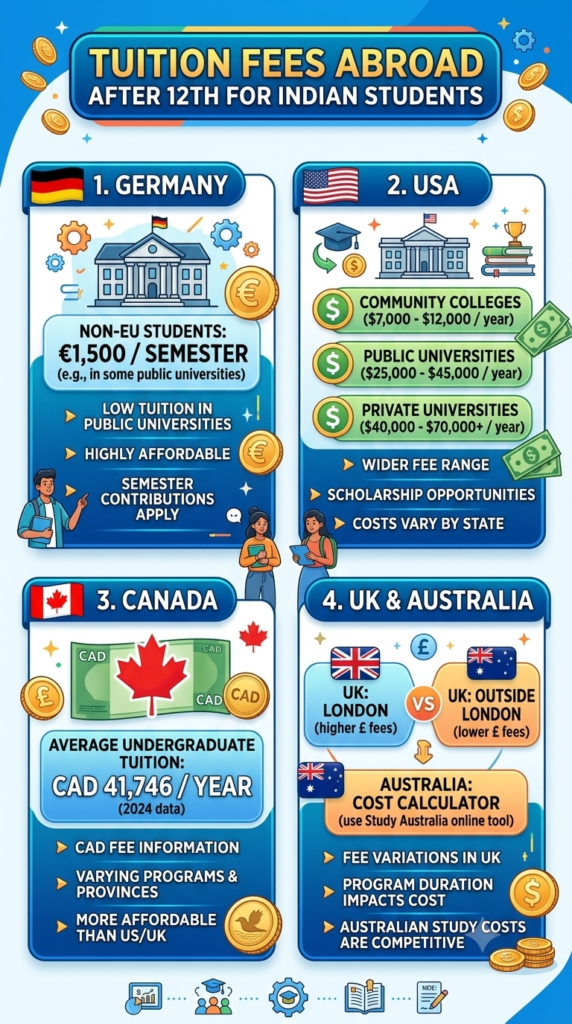
Tuition Fees in Germany
Students aiming to keep tuition costs a priority should consider Germany. Public higher education institutions usually do not charge tuition fees for most bachelor’s degree courses, although students are required to pay semester fees.
There are some significant implications. According to DAAD, non-EU students are required to pay €1,500 per semester in Baden-Württemberg for relevant degree programmes, and tuition fees may be required by some universities in Bavaria. Private universities may charge much higher tuition fees.
Students are also advised to check whether they have passed out their class 12 exam with the required marks in order to get admission to the university. Having a low tuition fee doesn’t help if the student does not qualify for direct admission to the desired bachelor’s degree programme.
Tuition Fees in the USA
The United States offers a variety of universities, including community colleges, public universities, and private four-year universities. There is a wide range of tuition and required fees.
EducationUSA advises that you make a financial plan early and review the cost of the particular university. It also advises students that most scholarships only pay for part of their education and living costs, and some scholarships are not open to first-year international students.
Include scholarship conditions and renewal rules when estimating the study abroad cost after 12th for Indian students.
Tuition Fees in Canada
The tuition costs for Canadian universities and colleges vary by institution, programme and level of study. EduCanada’s published tuition figures for international undergraduate university students average CAD 41,746 per year. There is a different fee structure for college diploma programmes.
Research each Canadian institution individually to estimate the study abroad cost after 12th for Indian students. Even if the tuition is less expensive, a college diploma does not necessarily qualify someone for a university bachelor’s degree.
Tuition Fees in Australia and the UK
Tuition fees differ by institution, course and location in Australia. The Study Australia official website provides students with information on courses and a calculator to help students estimate the cost of living.
Tuition fees vary across universities and programmes in the UK. Students are advised to refer to the university official fee schedule and estimate the cost of living based on the city they plan to move to. The student visa maintenance requirements differ between London and outside of London.
Living Expenses for Indian Students Abroad
Living expenses form a significant part of the study abroad cost after 12th for Indian students, particularly in cities with high rent and transportation costs.
When estimating the study abroad cost after 12th for Indian students, include rent, food, transportation, utilities, insurance, and personal expenses.
One of the highest costs often is accommodation. The rent depends on the city where you’re staying, the distance from the university, type of rent and whether utilities are included or not.
Main Living Expenses
| Expense | Factors Affecting Cost | Ways to Manage It |
| Accommodation | City, room type and location | Compare student residences and shared housing |
| Food | Grocery prices and eating habits | Cook meals and plan weekly groceries |
| Transportation | Distance and local transport options | Explore student passes and nearby housing |
| Utilities | Electricity, heating, water and internet | Check which bills are included in rent |
| Mobile and internet | Provider and data plan | Compare student or prepaid plans |
| Study materials | Course and subject requirements | Check library access and legitimate used-book options |
| Personal expenses | Lifestyle and shopping habits | Set a monthly spending limit |
| Healthcare | Insurance rules and individual needs | Confirm mandatory coverage before departure |
Accommodation Costs
Students are typically able to compare different types of university accommodation, shared apartments, private rentals, and homestays (when available).
While it may be convenient to live on campus, it may not always be the most affordable choice. Students may receive a lower rent in their shared home, but should keep in mind the expenses of commuting, utilities, deposits, and the consistency of the landlord.
Before signing an agreement read the length of the contract, cancellation terms, the deposit and if furniture and utilities are included in the contract.
Food and Daily Expenses
Cooking food at home will help students to manage their money. Students should make a monthly grocery budget and make room for eating out, going out to socialize and buying things they need.
Indian students should also look into the cost and availability of the groceries they are used to in the city they choose to live. The budget, however, should include local prices instead of assumptions for the cost of food throughout the entire country.
Transportation
Being near campus can save time and money on commuting, but housing near a college or university may cost more.
Consider both rent and transportation expenses instead of rent only when selecting a home. Renting a room further away might be more expensive when cost of daily travel is added.
Visa, Insurance, Travel and Other Costs
Students should budget an additional expense amount for any expenses that occur before departure or are not covered by university tuition.
These additional expenses should be included when calculating the study abroad cost after 12th for Indian students, as they can increase the amount families need to arrange before departure.
Student Visa and Proof of Funds
To apply for a student visa, a student might need to submit an application fee together with supporting documents and evidence of adequate financial resources.
An amount of money does not necessarily indicate the actual amount that will be spent by a student for visa. Financial eligibility is a requirement which must be verified on the basis of the current eligibility rules.
For example:
- Germany: DAAD provides information on financial proof (blocked account or recognised scholarship). All figures and instructions should be verified against the most recent guidance for missions from Germany.
- Canada: Immigration, Refugees and Citizenship Canada sets out the financial-support amounts to be demonstrated, in addition to tuition and transportation. The figure that applies will depend on the circumstances and application date.
- Australia: The Department of Home Affairs wants applicants to take into account course fees, travel and living costs. It has a student living-cost benchmark, which is published as AUD 29,710 (for 12 months).
- UK: Student visa applicants typically require to show very high course fees for the course period and maintenance funds, depending on the location of study (London or outside London).
Be sure to check the current regulations before paying or applying.
Health Insurance
Requirements for health insurance vary from country-to-country, and may even vary within individual universities. Depending on the policy, students may be required to have an approved policy, join a health insurance plan (National or Local) or satisfy policy requirements.
Consider the premium, payment schedule, excess/deductible, and exclusions in your budget. Check insurance separately when calculating the study abroad cost after 12th for Indian students.
Airfare and Initial Settlement
Flight fares from India vary according to the destination, season, booking date, baggage allowance and route.
Students should also make budgetary decisions for their initial accommodation costs, bedding and kitchen items, local transportation, a SIM card, and other necessities. Include these upfront payments in the study abroad cost after 12th for Indian students.
Hidden Expenses Students Often Forget
When calculating the “study abroad cost after 12th for Indian students”, some expenses are easily overlooked.
- Application fees to the University and document courier fee.
- English language tests (or other tests as required)
- Passport and visa-related expenses
- Document translation/certification (where applicable)
- Deposit for housing and rental costs (in advance)
- Bank transfer and currency-conversion fees
- Computer-based tools, machines, or lab material that is required for the course.
- Traveling clothes/any other travel specific items
- Travel and/or emergency medical costs
- Hikes in tuition and rent on an annual basis.
Not all students are going to be paying all items. Create your own checklist with the university’s instructions and the visa requirements for the destination at the time of application.
Cheapest Countries to Study Abroad After 12th
Students looking for the “cheapest countries” to study abroad must consider the full cost of studying abroad when making a decision, not just tuition fees.
To find an affordable study abroad cost after 12th for Indian students, compare total tuition, living expenses, visa requirements, and confirmed scholarships rather than tuition fees alone.
The cost of a country with low tuition can be high if the rent, insurance and daily costs are high. Likewise, if a student has been awarded a scholarship at a college or university with high tuition, it can make the college more affordable.
Which Countries Should Budget-Conscious Students Consider?

1. Germany
Germany should be considered due to the fact that many of the universities do not charge tuition fees for eligible bachelor’s programmes. However, the contributions for the semesters, the expenses of living, the insurance and requirements for the financial-proof are applicable. It is also students’ responsibility to see whether they are academically qualified and whether the language of instruction is English.
Official source: DAAD cost and finance guide
2. South Korea
Students interested in undergraduate scholarships may want to explore South Korea. One of the opportunity for funding is Global Korea Scholarship Undergraduate (GOSU), based on the updated eligibility requirements and selection process. Once students have taken confirmed funding into account, they should compare tuition, accommodation and other expenses.
Official source: Study in Korea
3. Italy
For students looking at other universities in Europe, Italy could be a place to consider, especially in terms of public-university tuition fees and scholarships in the region. The actual affordability depends on the individual university, course, city and financial support eligibility. Students should refer to the official rules governing scholarships in the region and university.
Research starting point: Study in Italy official portal
4. Malaysia
If the students are searching for universities in Asia, they can consider Malaysia as it is worth it to be compared. Please read through the full international student fee schedule, living arrangement, insurance policy and language of instruction before deciding to make a choice.
Research starting point: Education Malaysia
5. Canada
Another option is Canada, but students should not take it for granted that it is a low-cost place. Undergraduate tuition and living costs may be high for international students. When looking at specific institutions, as well as scholarships and cities, consider whether the overall price is within your budget.
Official source: EduCanada study costs
These are destinations to explore, rather than a ranking of cheapest to most expensive. The precise sequence of the order is dependent on the course, university, city, scholarship and exchange rate.
How Scholarships Can Reduce the Cost
Scholarships can reduce the study abroad cost after 12th for Indian students by covering part or all of eligible tuition fees and, in some cases, living expenses. Students should confirm the award conditions before including funding in their budget.
The scholarship may be for 100% of tuition, a percentage of tuition, living costs, or a combination of eligible costs. Certain awards are restricted to students who have an outstanding academic record and others are based on financial requirement, leadership or other factors.
Students from India looking to pursue their education in a foreign country after Class 12 have a number of funding options to explore which are listed below:
- University merit scholarships
- Need-based financial aid
- Government-funded undergraduate scholarships
- University or regional grants
- External scholarships from recognised foundations
For instance, EducationUSA offers details on financial aid options at American universities, while the Global Korea Scholarship offers an undergraduate path. The specific program determines availability and award requirements.
Students can also explore our related guide: Scholarships for Indian Students to Study Abroad After 12th.
Before including a scholarship in the budget, ensure that the student has received it, that it is applicable to the projected intake, and that it will continue in subsequent academic years.
How to Calculate Your Total Study Abroad Budget
The practical budget should include the entire degree and not just the first semester.
To estimate the study abroad cost after 12th for Indian students accurately, calculate annual expenses, add one-time costs, and subtract only confirmed funding.
Follow these steps:
Step 1: Calculate Annual Tuition
Check out the official tuition cost of the specific undergraduate course. Determine if the amount is for one semester or the entire school year.
Look into whether tuition will increase in subsequent years, and whether there are extra fees for lab, exams or course materials.
Step 2: Calculate Annual Living Expenses
Make a budget for personal expenses, utilities, insurance, transportation, and food for 12 months or the length of time you will be abroad.
Aim for an official university estimation for the number of people living in the town, and a realistic price of living in the town.
Step 3: Add One-Time Costs
Cover visa fees, airfares, application fees, document preparation and initial settlement costs.
Never consider a refundable deposit as an ongoing cost without reading the terms and conditions. But make sure you have sufficient money to pay it when needed.
Step 4: Subtract Confirmed Funding
Deductions for scholarships, grants or other funding should only be deducted after the amount and conditions are verified.
Don’t assume that a part-time job will pay for your basic costs. Depending on destination and personal situation there are different possibilities of employment, allowed working hours and actual earnings.
Step 5: Add an Emergency Reserve
Set aside some extra money in case of unforeseen events or currency fluctuations. The requirements for the reserve vary based on your finances and where you are going.
Sample Study Abroad Budget Calculator
Use this calculator to estimate the study abroad cost after 12th for Indian students based on annual expenses, confirmed funding, and the duration of the degree. Fill in the amounts in the same currency (e.g. euros, pounds, Canadian dollars, Australian dollars).
Study Abroad Budget Calculator
Estimate your undergraduate study costs. Enter all amounts in the same currency.
4 years of estimated expenses plus one-time costs.
This is an estimate, not an official university or visa quote. Costs and funding may change each year. Enter confirmed funding only.
This calculator serves as a foundation. Determine whether tuition, rent, or scholarship amounts will vary from year to year before making a final decision.
Common Mistakes Students Should Avoid
Estimating the study abroad cost after 12th for Indian students requires checking the full degree cost, not just the first year's tuition fees.
Avoiding these mistakes helps students estimate the study abroad cost after 12th for Indian students more accurately.
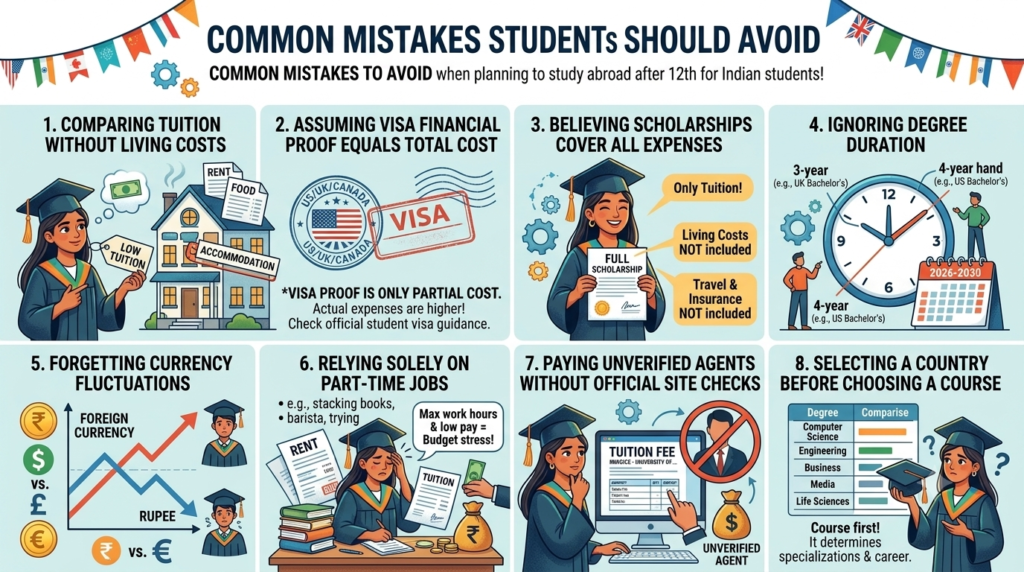
1. Comparing tuition without taking living costs into consideration. A low tuition fee is not a guarantee of the affordability of the degree.
2. Considering visa costs as the overall expense. Financial requirements for Visa are used as an indicator of eligibility and may not be reflected in the total amount a student will be required to pay.
3. Believing that scholarships include all expenses. Make sure to read the award letter for any restrictions, renewal requirements and any outstanding balance.
4. Not paying attention to the length of the degree. An affordable annual programme can still add up to a high cost after three, four or five years.
5. Forgetting currency fluctuations. If the exchange rate changes, the transfer needed by an Indian family would change accordingly.
6. Relying solely on part time jobs. Students should have a realistic funding plan before leaving; not depending on future earnings to cover tuition costs and basic living expenses.
7. Payment of an agent without reference to official information. Check university admissions criteria, costs, refunds and scholarship eligibility requirements directly with the university.
8. Selecting a country before selecting an appropriate course. Compare academic requirements, language requirements, accreditation, and career goals as well as financial requirements.
What Students Should Do Next?
To estimate the study abroad cost after 12th for Indian students, record the annual tuition, living expenses, one-time costs, confirmed scholarships, and total degree duration for each shortlisted university.
Make a spreadsheet with the following details for each university that has been shortlisted before applying:
| Item to Compare | What to Record |
| University and course | Exact programme name |
| Annual tuition | Official published fee |
| Degree duration | Total number of academic years |
| Accommodation | Monthly rent and deposits |
| Living expenses | Food, transport and personal costs |
| Insurance | Required coverage and annual premium |
| Visa requirements | Current financial proof and fees |
| Scholarships | Confirmed amount and renewal rules |
| Other expenses | Travel, application and settlement |
| Total estimated cost | Annual and full-degree budget |
Students can begin with the official cost information provided by DAAD for Germany, EducationUSA for the United States, EduCanada and Study Australia.
For more guidance, explore Pantivora's Study Abroad After 12th guide.
The goal is to reduce the number of institutions that provide the appropriate education at a price that your family can afford. Examine the entire cost of the degree rather than simply the first year's tuition or the headline of a scholarship.
FAQs About Study Abroad Costs After 12th
1. What will be the cost of studying abroad after 12th for Indian students?
Total cost will depend on country, university, course and lifestyle. Students need to account for tuition, accommodation, food, insurance, visa expenses, travel and other costs. The best idea of the cost of a university is based on the fee schedule of the chosen university and the official living cost and visa advice provided by the destination. Comparing these expenses across universities is the best way to estimate your individual study abroad cost after 12th for Indian students.
2. Which country is the best for Indian students to study abroad after 12th?
The cheapest country for each student is different. Germany is also an option to consider as many universities there do not require any tuition fees for eligible bachelor's degrees, with some exceptions and a high cost of living. Students should also compare where they want to go, like South Korea, Italy and Malaysia, etc. on actual course fees and living expenses.
3. Is there any option for Indian students to study abroad after passing 12th without paying tuition fees?
Yes, in some circumstances. Student can receive a full tuition scholarship or admission to an eligible public university, which does not generally charge tuition for the programme. However, other costs, such as living expenses, insurance, travel, etc. may still be due.
4. What is a suitable amount of money for parents to save before sending a student overseas?
The amount is dependent on the course, country, university and confirmed funding. Parents need to plan for the initial tuition fees, visa financial requirements, accommodation, travel, insurance and settlement costs. They should also make plans for the coming academic years, rather than just the first few months.
5. Can scholarships be used for both tuition and living costs?
Some scholarships may include tuition and living expenses, others may apply only to tuition. All students need to read the official award conditions and verify if the funding is renewable, when are payments made and what expenses are kept on their own account.
Conclusion
Before choosing a country or university, it is crucial to understand the “study abroad cost after 12th for Indian students.” Tuition fees, accommodation, food, insurance, visa costs, travel and other costs that may occur during the degree are all included in the total cost.
Germany might be an attractive option for students interested in pursuing their studies at an eligible public university where the tuition fee is low, while the USA, Canada, Australia and the UK provide a variety of university choices and financial-aid options.
As per the course and budget, other destinations such as South Korea, Italy, and Malaysia are worth researching. Choosing the country with the lowest tuition fee is not necessarily the best choice. It is to choose a recognized and appropriate university, estimate full degree expenses, check visa requirements and apply for scholarships that are eligible for the student.
If Indian students and parents plan ahead and get accurate information from official sources, they can accurately assess a realistic choice and make a well-informed decision regarding overseas education.