
Students must simultaneously assess countries, courses, costs, scholarships, paperwork, admission dates, and visa requirements while planning to study abroad after 12th grade, which can be confusing.
Budget, academic stream, long-term career objectives, language comfort, post-study employment opportunities, and family preferences all influence the ideal nation and course for Indian students. While a student interested in commerce could consider the UK, Canada, or Australia, an engineering student might prefer Germany, the USA, or Canada. Germany and a few other European nations are also options for those seeking less expensive tuition.
This guide covers every stage of the procedure for studying abroad from India after 12th grade in 2026, including country comparison, course selections, eligibility, fees, scholarships, necessary paperwork, typical mistakes, and frequently asked questions.
Students should analyse the best career options after 12th before applying overseas in order to select a degree that fits their long-term objectives, budget, and stream.
Table of Contents
Why More Indian Students Are Choosing to Study Abroad After 12th in 2026?
After completing their Class 12 exams, many of Indian students encounter the most significant turning point in their lives: what comes next? For an increasing number of individuals, the answer is no longer restricted to domestic universities and entrance tests. For students in the fields of science, business, and the arts, choosing to study abroad after 12th has become a common, calculated, and transformative option.
It is evident from the numbers. Currently, India is the second-largest supplier of overseas students worldwide, and an important part of that group is made up of students who departed immediately after completing the 12th grade. They are pursuing global exposure, industry-aligned education, post-study work visa prospects, and long-term career opportunities abroad that are just not accessible in the same manner at home, in addition to foreign degrees.
You’ve come to the right place if you’re a parent or student reading this. This guide includes all you need to know about study abroad after 12th – from selecting the correct destination and course to comprehending fees, scholarships for Indian students, and eligibility requirements.
What Are the Benefits of Choosing to Study Abroad After 12th?
Understanding the why is important before moving on to the how. Choosing to study abroad after 12th has several long-term benefits that go well beyond getting a foreign degree.
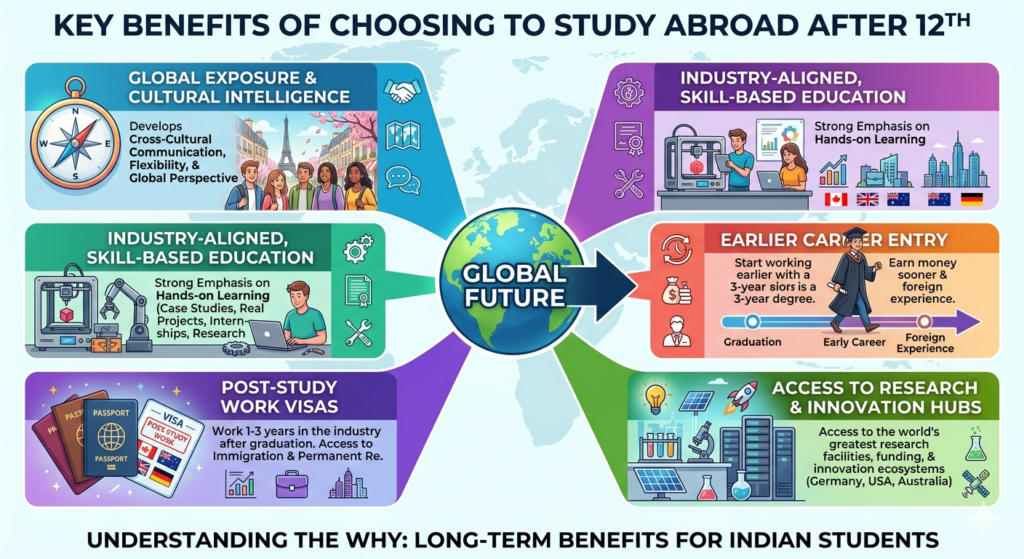
- Global Exposure & Cultural Intelligence: Studying and living abroad develops cross-cultural communication abilities, flexibility, and a global perspective—qualities that top companies actively seek out. It is challenging to replicate this type of exposure at home.
- Industry-Aligned, Skill-Based Education: Universities overseas place a strong emphasis on hands-on learning through case studies, real projects, internships, and research, in contrast to the examination-focused framework that many Indian students are used to. This bridges the career opportunities abroad gap between academics and the real world.
- Post-Study Work Visas: Following graduation, international graduates can work in their industry for one to three years in countries including Canada, the UK, Australia, and Germany that have organized post-study work visa programs. This gives many people access to immigration and permanent residency.
- Earlier Career Entry: A three-year undergraduate degree in the UK or a certificate program in Canada allows you to start working earlier, earn money sooner, and gain foreign experience, all of which greatly enhance your professional path.
- Access to Research and Innovation Hubs: Studying at institutions in Germany, the USA, or Australia gives you access to some of the world’s greatest research facilities, funding, and the innovation ecosystems if you have a strong interest in STEM.
Best Countries to Study Abroad After 12th for Indian Students
No nation is the best in the world. Your work ambitions, long-term aspirations, budget, and stream all play a role in choosing the best location. Here’s a full overview of the most popular options for students looking to study abroad after 12th:
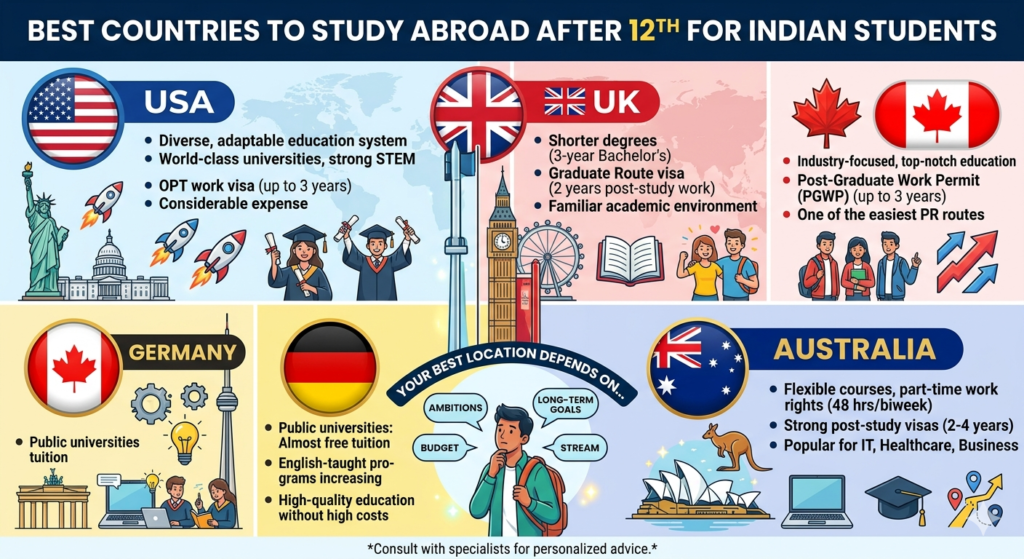
- The United States has a diverse, adaptable educational system that includes world-class colleges and robust STEM programs. Graduates are permitted to work for up to three years under the Optional Practical Training (OPT) work visa. However, it is one of the most expensive choices.
- The UK is well-liked because a lot of bachelor’s degrees are finished in three years, which might shorten the time spent studying overall. After finishing a qualifying degree in the UK, eligible students may remain under the Graduate visa; however, the length of stay varies depending on when the student applies. For applications submitted on or before December 31, 2026, it lasts two years; for those submitted on or after January 1, 2027, it lasts eighteen months; and for PhD or doctorate graduates, it lasts three years.
- Canada is popular among Indian students due to its academic quality, practical courses, and potential post-graduate employment opportunities. However, the length of the PGWP is determined by the program’s level and duration, passport validity, and current qualifying requirements. Before selecting a course, students should carefully verify official immigration updates because permanent residency is not guaranteed.
- Germany is unique due to its almost free public university tuition. Although undergraduate programs frequently demand a strong command of German, English-taught programs are becoming more and more accessible. For students who desire a high-quality education without having to worry about paying for it, it is the preferred option.
- Australia offers excellent prospects in IT, healthcare, and business, as well as flexible course options and reputable universities. Subject to the terms of their visa, international students on a student visa are often permitted to work up to “48 hours per fortnight” while their classes are in session and unlimited hours during planned breaks.
Learn about studying in the USA on Education USA: https://educationusa.state.gov
Explore UK study options via UCAS: https://www.ucas.com
Check study permits and PR pathways on Government of Canada: https://www.canada.ca
Find tuition-free universities via DAAD: https://www.daad.de
The NEET 2026 registration guide should be consulted by medical candidates comparing MBBS programs overseas with Indian medical institutions in order to fully understand the exam procedure and crucial requirements.
Country-Wise Comparison Table for Indian Students
| Country | Best For | Typical UG Duration | Approx. Tuition Range | Post-study Work Option |
| USA | STEM, business, research, high-ranking universities | 4 years | High | OPT / STEM OPT depending on course |
| UK | Shorter bachelor’s degrees, business, law, humanities | 3 years | Medium–High | Graduate visa route |
| Canada | Affordable options, PR-focused students, business, tech | 3–4 years | Medium | PGWP may range from 8 months to up to 3 years depending on program |
| Germany | Low tuition, engineering, STEM, research | 3–4 years | Low in many public universities | Post-study job search/work options vary by visa rules |
| Australia | Healthcare, IT, business, hospitality, flexible work options | 3–4 years | Medium–High | Temporary graduate/work options depend on course and visa category |
Important Visa Note: Scholarship, work permit, and visa regulations are subject to annual changes. Before making decisions, students should always check the most recent information on official government and institution websites.
Which Courses After 12th Are Best to Pursue Abroad?
Your entire experience, including your professional path and university prospects, will be shaped by the course you select. Based on your stream, consider it as follows:
Study Abroad After 12th for Science Students
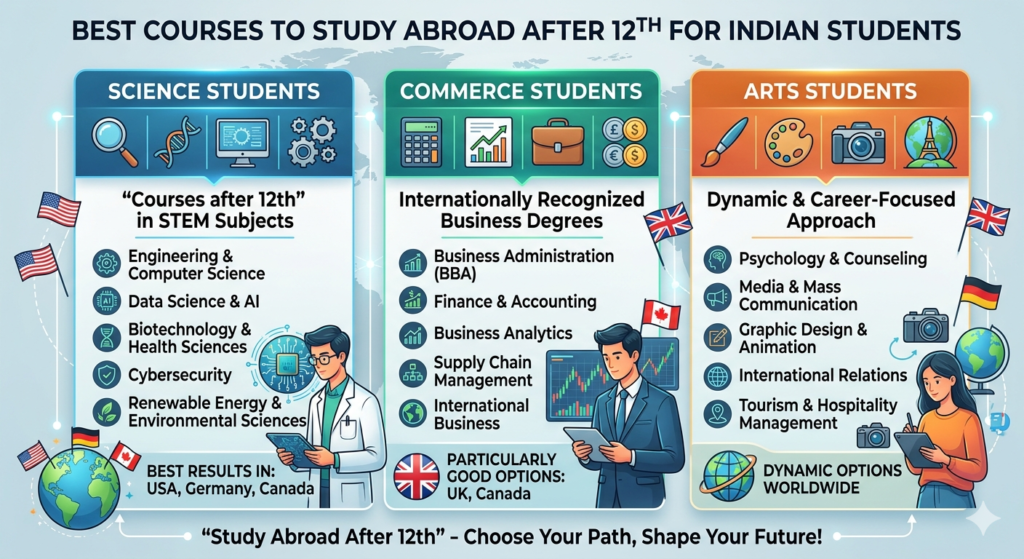
Science students typically have a diverse choice of undergraduate opportunities overseas, particularly in engineering, computer science, data science, biotechnology, healthcare, cybersecurity, and environmental science.
Study Abroad After 12th for Commerce Students
A growing number of commerce students are opting to study abroad after 12th in order to obtain internationally recognized business degrees. Business Administration (BBA), Finance and Accounting, Business Analytics, Supply Chain Management, and International Business are among the most popular courses after 12th for commerce. The United Kingdom and Canada are particularly good options here.
Study Abroad After 12th for Arts Students
International institutions frequently provide a much more dynamic and career-focused approach to artistic and social subjects, according to art students. Psychology and counseling, media and mass communication, graphic design and animation, international relations, and tourism and hospitality management are among the most popular courses after 12th for arts students.
Eligibility Requirements to Study Abroad After 12th from India
One of the most crucial tasks in preparing to study abroad after 12th is figuring out what qualifications you need. Although specific criteria differ depending on the nation and university, the following is a typical summary:
Academic Requirements: The majority of colleges require a minimum of 60–75% in Class 12. Depending on the course, top-ranked US and UK universities may demand 75–85% or higher.
English Language Proficiency: The most commonly used assessments are the PTE, TOEFL, and IELTS. If you attended an English-medium school, some colleges provide study abroad without IELTS possibilities, although this isn’t always the case. The minimal criteria for the majority of locations is an IELTS score between 6.0 and 6.5.
Supporting Documents: Academic transcripts, a valid passport, a well-written Statement of Purpose (SOP), and Letters of Recommendation (LOR) are common requirements for any destination.
SAT/ACT (USA): Although many American colleges have switched to test-optional procedures since the pandemic, others may still demand SAT or ACT results for undergraduate enrollment.
- Explore TOEFL exam info on ETS TOEFL: https://www.ets.org/toefl
Documents Required to Study Abroad After 12th from India
Before applying to universities, students should prepare these documents:
1. Class 10 marksheet
2. Class 12 marksheet or predicted scores
3. Valid passport
4. Statement of Purpose
5. Letters of Recommendation
6. English test score such as IELTS, TOEFL, PTE or Duolingo, if required
7. Resume or student CV
8. Portfolio, if applying for design, media, architecture or creative courses
9. Proof of funds
10. Scholarship documents, if applying
11. University application form
12. Visa documents after admission
The best AI tools for students can help students find universities, plan deadlines, organize papers, and enhance their study process.
How Much Does It Cost to Study Abroad After 12th? Fees Breakdown for 2026
For Indian families thinking about study abroad after 12th, affordability is one of their main worries. A practical breakdown to aid with financial planning is provided below:
| Expense Category | USA | UK | Canada | Germany | Australia |
| Annual Tuition Fees | $20,000–$40,000 | £12,000–£25,000 | CAD 15,000–30,000 | Low/Zero (public) | AUD 20,000–35,000 |
| Annual Living Costs | $10,000–$18,000 | £9,000–£14,000 | CAD 10,000–15,000 | €8,000–12,000 | AUD 15,000–22,000 |
| Visa & Application Fees | $200–$500 | £490–£700 | CAD 150–350 | €75–150 | AUD 650–750 |
| Health Insurance | $1,000–$2,500/yr | £400–£700/yr | CAD 600–1,200/yr | €80–150/yr | AUD 500–700/yr |
It’s crucial to remember that scholarships for Indian students might considerably reduce these expenses. Germany continues to be the most economical major, especially for those studying science and engineering.
Scholarships for Indian Students After 12th
Students shouldn’t wait until the last minute to apply for scholarships because they can lower the overall cost of studying overseas. A solid academic profile, SOP, recommendation letters, and documentation of extracurricular accomplishments are all necessary for many scholarships, which have early deadlines.
Common scholarship options include:
1. University merit scholarships
2. Country-specific scholarships
3. Need-based financial aid
4. Subject-specific scholarships
5. Indian government or private foundation scholarships
6. Research or talent-based awards
Before submitting an application, students should always check the official university website because scholarship amounts, deadlines, and eligibility requirements are subject to annual changes.
Step-by-Step Process: How to Study Abroad After 12th from India in 2026
A methodical strategy is necessary for study abroad after 12th planning. A useful road map is as follows:
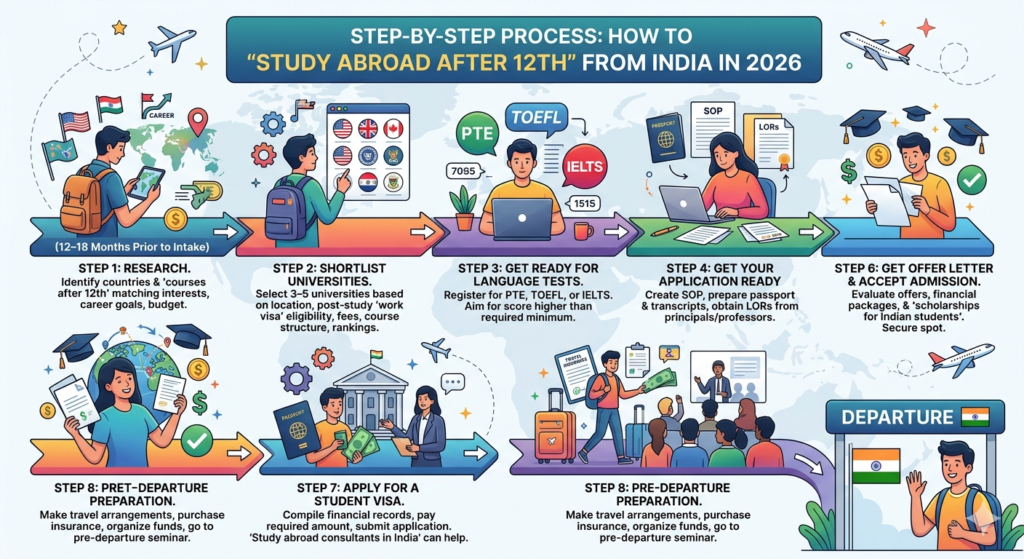
Step 1: Research (12–18 Months Prior to Intake): Determine which nations and courses after 12th fit your interests, professional objectives, and financial limitations.
Step 2: Shortlist Universities: Select three to five universities based on factors such as location, post-study work visa eligibility, fees, course structure, and rankings.
Step 3: Get Ready for Language Tests: Register for the PTE, TOEFL, or IELTS and get ready steadily. Aim for a score higher than the required minimum.
Step 4: Get Your Application Ready: Create your SOP, prepare your passport and academic transcripts, and obtain LORs from principals or professors.
Step 5: Submit Applications: Pay close attention to deadlines and submit applications to every university that has been shortlisted. Your chances of getting better financial offers are increased when you apply to several universities.
Step 6: Get an Offer Letter and Accept Admission: Before securing your spot, evaluate offers, financial packages, and scholarships for Indian students.
Step 7: Apply for a Student Visa: Compile your financial records, pay the required amount, and send in your application. Study abroad consultants in India can help with the paperwork and processing of visas.
Step 8: Pre-Departure Preparation: Make travel arrangements, purchase insurance, organize your funds, and go to a pre-departure seminar.
Compare global universities on QS World University Rankings: https://www.topuniversities.com
Common Mistakes to Avoid When You Study Abroad After 12th
Many students make preventable errors that result in financial loss, lost opportunities, or incorrect course selections. The most common ones include selecting a country based on trends rather than career objectives, focusing solely on tuition rather than the entire cost of education, applying too late and losing out on early-entry scholarships, failing to investigate post-study work visa regulations before selecting a location, and failing to speak with knowledgeable study abroad consultants in India who can offer individualized advice.
Frequently Asked Questions About Study Abroad After 12th
Ques. After 12th grade, is it possible for me to study overseas from India?
Ans. Yes, After finishing Class 12, Indian students who fulfill the academic, language and financial, and visa requirements may enroll for undergraduate programs overseas.
Ques. After the 12th grade, which nation is ideal for Indian students?
Ans. There isn’t just one ideal nation for all students. The United States excels in STEM and research, the United Kingdom excels in shorter undergraduate degrees, Canada is popular for long-term settlement plans, Germany is ideal for low-cost STEM programs, and Australia is popular for IT, healthcare, and business courses.
Ques. What percentage is needed to study overseas after the 12th grade?
Ans. While many institutions accept students with scores between 60 and 75 percent, competitive courses and universities may demand higher grades. Requirements differ depending on the nation, university, and course.
Ques. After 12th grade, can I study overseas without taking the IELTS?
Ans. If a student studies in English, certain universities might skip the IELTS exam, although this is not a given. Students should visit the official entrance page of each university.
Ques. Is it costly to study overseas after 12th grade?
Ans. It can be costly, particularly in the USA, UK, and Australia. However, the total cost can be lowered with scholarships, Germany’s inexpensive public colleges, part-time employment opportunities, and selective country selection.
Final Thoughts: Is Study Abroad After 12th the Right Choice for You?
The choice to study abroad after 12th is not universally applicable, but it can be one of the most life-changing decisions for those who are prepared to plan ahead, do extensive research, and make well-informed decisions. 2026 is one of the best years to make this move because of the mix of international education, post-study work visa chances, career opportunities abroad, and scholarships for Indian students.
Starting early, consulting the appropriate specialists, selecting courses after 12th based on long-term need, and having a clear idea of where you want to be in 10 years are all crucial. Boarding a plane is not the beginning of your overseas education experience. It begins as soon as you decide to go after something greater.
Pantivora wants to help Indian students with study abroad, career counseling, admission tests, and student resources. Visit the About Pantivora page for more information, or Contact Pantivora if you have any changes, comments, or suggestions for topics.